

SALOMÃO JÚLIO MANHIÇA

Childhood and schooling
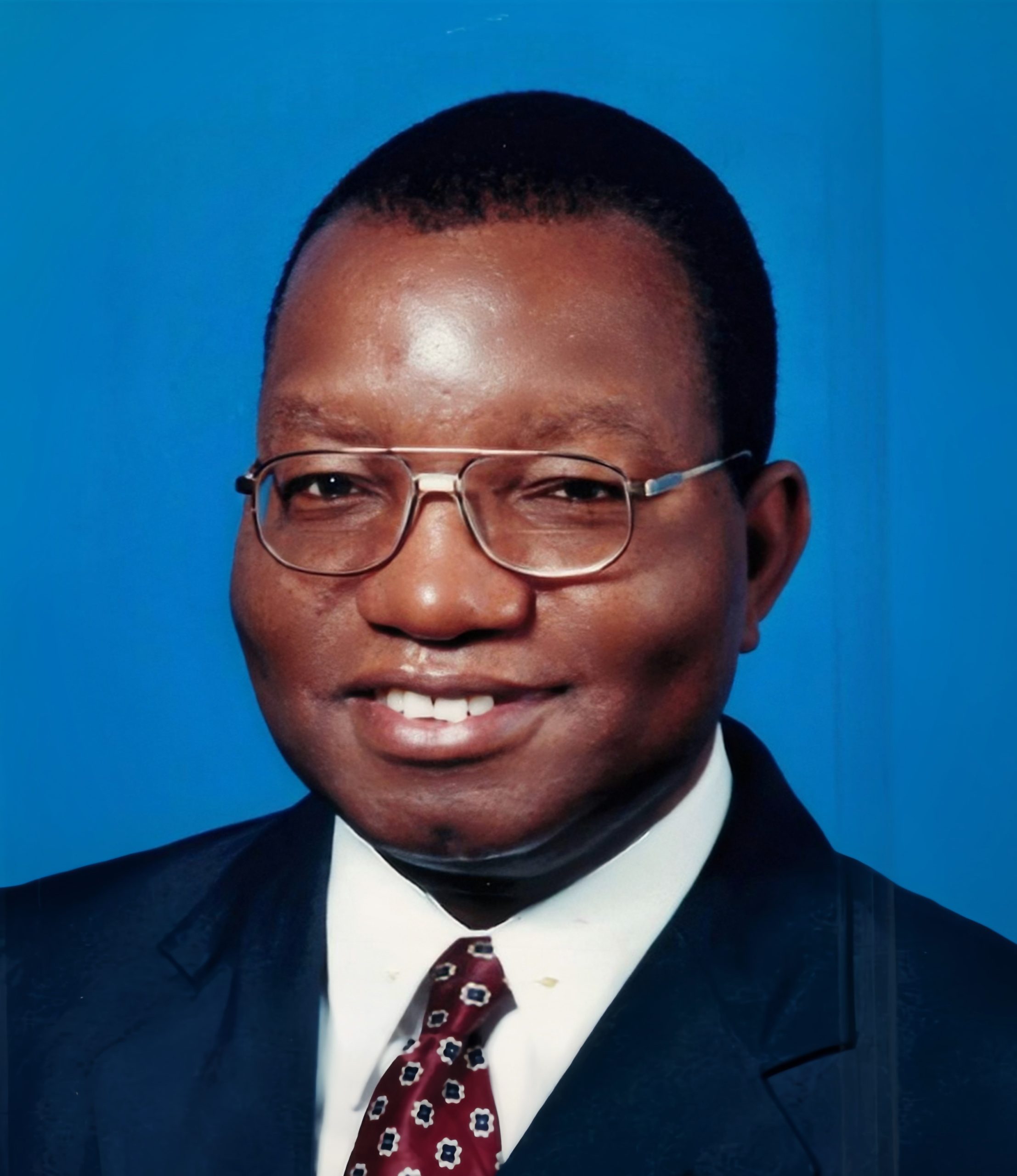
Salomão Júlio Manhiça was born in Calanga, Manhiça District, Maputo Province, in 1950, where he spent his childhood herding his father’s goats.
It was in his hometown that he completed the third grade of primary school. After that, he went to Lourenço Marques, now Maputo, to complete the third grade of elementary school and the fourth grade.
As he was a good student, one of his teachers and mentors, a nun, suggested that he enter the seminary to become a priest, which he accepted, given the difficulties he would face in continuing his secondary education, as his parents could not afford to pay for it.
He attended the Minor Seminaries of Magude and Christ the King in Namaacha for secondary school, where he learned to play the piano, and later transferred to the Major Seminary of St. Pius X in Maputo for pre-university education.
While still at the seminary, he was active in the Guild Church in Xipamanine, where he was an organist. He was also present at the Malhangalene Church, where he served as organist and singer.
He left the seminary at the beginning of his second year of theology and entered the job market.
Salomão Júlio Manhiça was born in Calanga, Manhiça District, Maputo Province, in 1950, where he spent his childhood herding his father’s goats.
It was in his hometown that he completed the third grade of primary school. After that, he went to Lourenço Marques, now Maputo, to complete the third grade of elementary school and the fourth grade.
As he was a good student, one of his teachers and mentors, a nun, suggested that he enter the seminary to become a priest, which he accepted, given the difficulties he would face in continuing his secondary education, as his parents could not afford to pay for it.
He attended the Minor Seminaries of Magude and Christ the King in Namaacha for secondary school, where he learned to play the piano, and later transferred to the Major Seminary of St. Pius X in Maputo for pre-university education.
While still at the seminary, he was active in the Guild Church in Xipamanine, where he was an organist. He was also present at the Malhangalene Church, where he served as organist and singer.
He left the seminary at the beginning of his second year of theology and entered the job market.
Higher Education
In 1972, he travelled to Portugal to study law at the University of Lisbon and music at the National Conservatory of Music in Lisbon. It is worth noting that in the entrance exams for the Faculty of Law, he was the candidate who obtained the best result in the entire Province of Mozambique, as Mozambique was then known. The two subjects in the exam were Latin and Philosophy.
In Lisbon, when he started classes, he was summoned by the Dean of the Faculty of Law, who shook his hand with a smile and told him that, of all the candidates who had taken the entrance exam that year, throughout Portugal, whether on the mainland, the islands or overseas, he had been the best, which naturally filled him with pride.
In 1972, he travelled to Portugal to study law at the University of Lisbon and music at the National Conservatory of Music in Lisbon. It is worth noting that in the entrance exams for the Faculty of Law, he was the candidate who obtained the best result in the entire Province of Mozambique, as Mozambique was then known. The two subjects in the exam were Latin and Philosophy.
In Lisbon, when he started classes, he was summoned by the Dean of the Faculty of Law, who shook his hand with a smile and told him that, of all the candidates who had taken the entrance exam that year, throughout Portugal, whether on the mainland, the islands or overseas, he had been the best, which naturally filled him with pride.
Integration into FRELIMO
With the coup d’état in Portugal on the 25th April 1974, he decided to leave Portugal to join FRELIMO.
Salomão Manhiça found it very interesting, at his first meeting of guerrilla fighters, of which he had become part, with the President of FRELIMO, to see and hear ‘those revolutionary songs’ being sung. This left him ‘absolutely amazed’. He was impressed by the habit of singing during military training, as he himself later discovered.
With his background in music, Salomão Manhiça composed some of FRELIMO’s songs:
– The Unity of Our People
– The Anthem of Mozambican Women
– Let Us Exalt Mondlane
He reports having written ‘The Unity of Our People’ while still in Algeria, on his way from Lisbon to Dar Es Salaam, where FRELIMO was based, and having improved it after his arrival in Nachingwea.
He also arranged and harmonised the vocals for many FRELIMO songs.
Having created the Mozambique People’s Liberation Forces Choir, he was gratified that the choir’s first performance at the FRELIMO Training Centre, for the President of FRELIMO, was in the company of the President of the United Republic of Tanzania, Julius Nyerere, and the President of Zambia, Kenneth Kaunda.
Salomão Manhiça attributes his success in creating the choir to his musical training at the seminary, on the one hand, and his attendance of the National Conservatory of Music, which he did in parallel with his law studies, on the other hand.
Upon his return to Mozambique in June 1975, Salomão Manhiça took part in the celebrations to mark the proclamation of independence, involved in the Mozambique People’s Liberation Forces Choir and the Mozambique People’s Liberation Forces Theatre Group, with theatrical and musical activities organised by the FRELIMO guerrilla fighters, of which he was an integral part.
With the coup d’état in Portugal on the 25th April 1974, he decided to leave Portugal to join FRELIMO.
Salomão Manhiça found it very interesting, at his first meeting of guerrilla fighters, of which he had become part, with the President of FRELIMO, to see and hear ‘those revolutionary songs’ being sung. This left him ‘absolutely amazed’. He was impressed by the habit of singing during military training, as he himself later discovered.
With his background in music, Salomão Manhiça composed some of FRELIMO’s songs:
– The Unity of Our People
– The Anthem of Mozambican Women
– Let Us Exalt Mondlane
He reports having written ‘The Unity of Our People’ while still in Algeria, on his way from Lisbon to Dar Es Salaam, where FRELIMO was based, and having improved it after his arrival in Nachingwea.
He also arranged and harmonised the vocals for many FRELIMO songs.
Having created the Mozambique People’s Liberation Forces Choir, he was gratified that the choir’s first performance at the FRELIMO Training Centre, for the President of FRELIMO, was in the company of the President of the United Republic of Tanzania, Julius Nyerere, and the President of Zambia, Kenneth Kaunda.
Salomão Manhiça attributes his success in creating the choir to his musical training at the seminary, on the one hand, and his attendance of the National Conservatory of Music, which he did in parallel with his law studies, on the other hand.
Upon his return to Mozambique in June 1975, Salomão Manhiça took part in the celebrations to mark the proclamation of independence, involved in the Mozambique People’s Liberation Forces Choir and the Mozambique People’s Liberation Forces Theatre Group, with theatrical and musical activities organised by the FRELIMO guerrilla fighters, of which he was an integral part.
Culture: As a Military Man and in the Civil Service
After the proclamation of national independence, Salomão Manhiça was placed in the General Staff of the Popular Forces for the Liberation of Mozambique in the area of culture.
Salomão Manhiça was part of the theatre commission created in 1976 by the Minister of Education and Culture and was one of the first staff members to join the National Institute of Culture. He was invited to the National Culture Meeting in July 1977, which made recommendations for cultural action at the national level and decided on activities to be carried out in relation to singing, dancing, theatre, poetry, literature, crafts, visual arts, the promotion of reading, the preservation of oral tradition and the promotion of museums, cultural centres, cultural groups in neighbourhoods, factories and communal villages.
As National Director of Culture, a position to which he was appointed in December 1977, Salomão Manhiça managed the National Museum Service, including the museums under its jurisdiction, the National Institute of Culture and the National Library Service.
After a stint at the Ministry of Justice as Chief of Staff, he was appointed National Director of Culture by the Minister of Education and Culture in 1977. In 1983, he became National Director of Cultural Action, a position he held until 1987.
As National Director of Culture, a position to which he was appointed in December 1977, Salomão Manhiça managed the National Museum Service, including its dependent museums, the National Institute of Culture and the National Library Service.
As National Director of Culture, Salomão Manhiça was involved in organising the first National Folk Dance Festival in 1978, one of the most significant events ever held in the country and considered the most important event of the year.
The National Dance Festival served as the basis for the creation of the National Singing and Dance Group in 1979.
It was also under his guidance that the first Traditional Song and Music Festival took place in 1980.
He wrote the Teachers’ Anthem while he was National Director, finding time for his work as a composer.
Management and Leadership Roles
After national independence, he moved beyond the world of music and was given new responsibilities.
1976–1977 – Chief of Staff to the Minister, Ministry of Justice.
1977–1983 – National Director of Culture, Ministry of Education and Culture.
1983-1987 – National Director of Cultural Action, Secretary of State for Culture and, later, Ministry of Culture.
1993-1994 – Secretary General, Ministry of Culture and Youth.
1994-1997 – Deputy Minister of Culture, Youth and Sports.
1997 – 1998 – Lecturer and Consultant, Eduardo Mondlane University.
1998 -2000 – Senior Manager responsible for Information and Communication Technologies and Public Relations, UNDP Mozambique.
1998 – 2002 – Executive Secretary, Commission for Information Technology Policy.
2002 – 2011 – Executive Secretary, Technical Unit for the Implementation of Information Technology Policy (UTICT).
2003 – 2009 – Chairman of the Board of Directors, National Communications Institute of Mozambique (INCM), the regulatory authority for the postal and telecommunications sectors.
After national independence, he moved beyond the world of music and was given new responsibilities.
1976–1977 – Chief of Staff to the Minister, Ministry of Justice.
1977–1983 – National Director of Culture, Ministry of Education and Culture.
1983-1987 – National Director of Cultural Action, Secretary of State for Culture and, later, Ministry of Culture.
1993-1994 – Secretary General, Ministry of Culture and Youth.
1994-1997 – Deputy Minister of Culture, Youth and Sports.
1997 – 1998 – Lecturer and Consultant, Eduardo Mondlane University.
1998 -2000 – Senior Manager responsible for Information and Communication Technologies and Public Relations, UNDP Mozambique.
1998 – 2002 – Executive Secretary, Commission for Information Technology Policy.
2002 – 2011 – Executive Secretary, Technical Unit for the Implementation of Information Technology Policy (UTICT).
2003 – 2009 – Chairman of the Board of Directors, National Communications Institute of Mozambique (INCM), the regulatory authority for the postal and telecommunications sectors.
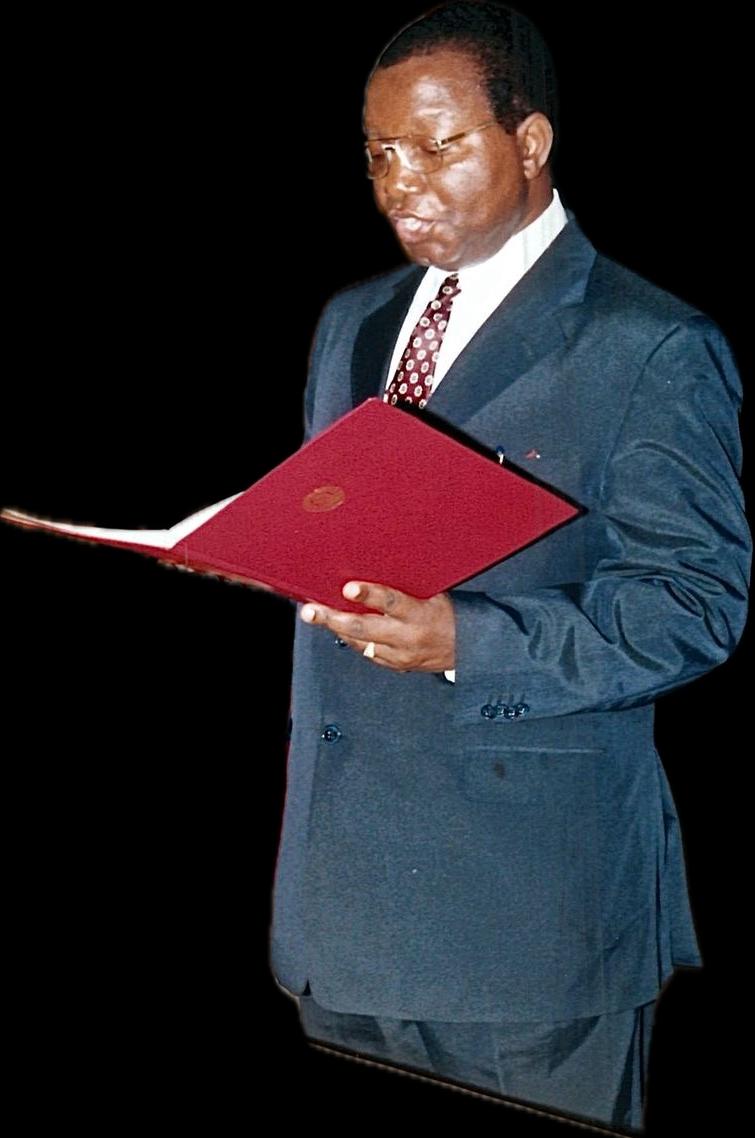
Swear-in as Chairman of the Board of Directors of INCM
2006 – 2012 – Lecturer, School of Communication and Arts, Eduardo Mondlane University.

Salomão Manhiça carrying a student’s baby on his back to allow her to write her exam
2008 – 2009 – Chair, Commonwealth Connects Steering Committee (based in London).
2011 – 2013 – Director, National Institute of Information and Communication Technologies (INTIC).
Education
1957 – 1960 – Saint Teresinha of the Child Jesus School in Marrumbana, Calanga, Manhiça, 1st and 2nd grades and 3rd grade rudimentary.
1960 – 1962 – São João de Brito School (now known as Malhangalene Primary School), 3rd elementary class and 4th class.
1962 – 1963 – Magude Minor Seminary, 1st year.
1963-1967 – Christ the King Minor Seminary in Namaacha, 2nd to 5th year.
1967-1971 – St. Pius X Major Seminary, three years of philosophy at secondary school level plus one year of pre-university theology.
1972 – 1974 – Faculty of Law, University of Lisbon, and National Conservatory of Music of Lisbon, Portugal.
1991 – M.A., Ethnomusicology, University of Washington, Seattle, USA.
1992 – Ph.D. (ABD), Ethnomusicology, University of Washington, Seattle, USA.
2011 – 2013 – Director, National Institute of Information and Communication Technologies (INTIC).
Education
1957 – 1960 – Saint Teresinha of the Child Jesus School in Marrumbana, Calanga, Manhiça, 1st and 2nd grades and 3rd grade rudimentary.
1960 – 1962 – São João de Brito School (now known as Malhangalene Primary School), 3rd elementary class and 4th class.
1962 – 1963 – Magude Minor Seminary, 1st year.
1963-1967 – Christ the King Minor Seminary in Namaacha, 2nd to 5th year.
1967-1971 – St. Pius X Major Seminary, three years of philosophy at secondary school level plus one year of pre-university theology.
1972 – 1974 – Faculty of Law, University of Lisbon, and National Conservatory of Music of Lisbon, Portugal.
1991 – M.A., Ethnomusicology, University of Washington, Seattle, USA.
1992 – Ph.D. (ABD), Ethnomusicology, University of Washington, Seattle, USA.
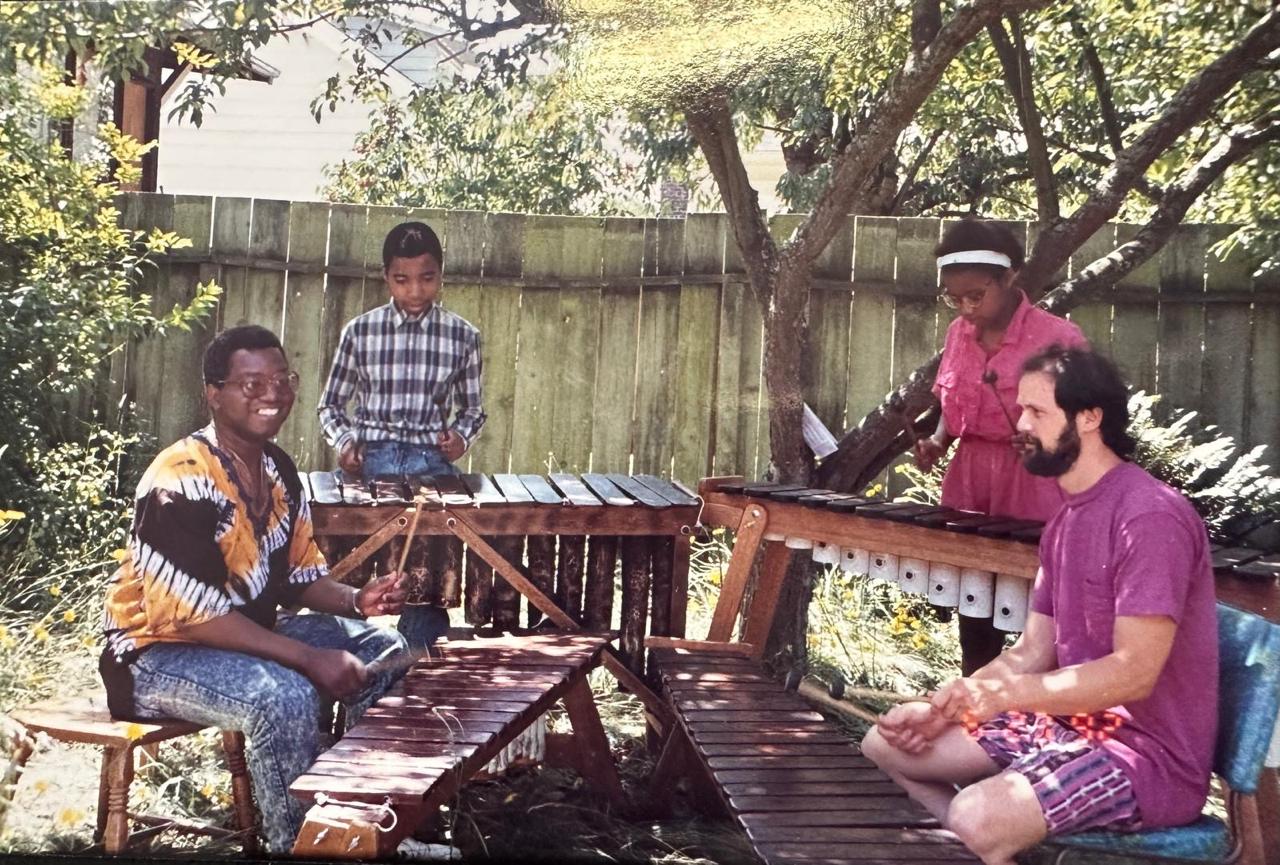
Salomão Manhiça and his sons rehearsing marimbas in the USA
Musical Training
He left for the USA in 1988 to pursue a master’s degree in Music at the University of Washington School of Music in Seattle, earning a Master of Arts degree in ethnomusicology.
He left for the USA in 1988 to pursue a master’s degree in Music at the University of Washington School of Music in Seattle, earning a Master of Arts degree in ethnomusicology.
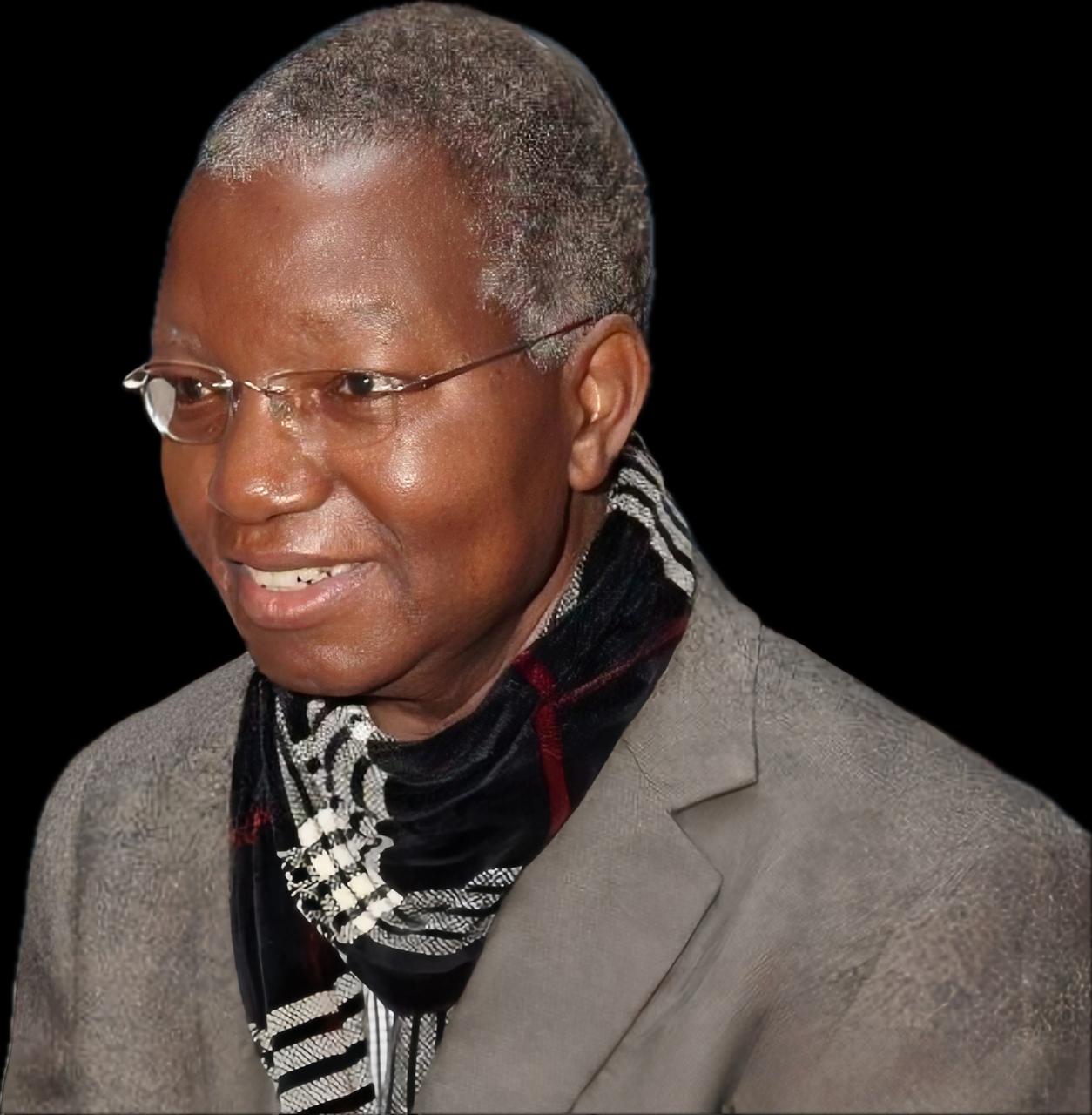
Thanks to his exceptional performance in the master’s programme, his scholarship was extended to give him access to the doctoral programme, the academic part of which he completed in 1992, leaving only his dissertation, that he intended to write in Mozambique after his return in 1992.

Member of the Government
In 1994, he was appointed Deputy Minister of Culture, Youth and Sports.

Author of the National Anthem Beloved Homeland
In 2002, his proposal for a National Anthem, drafted years earlier, was accepted and approved by the Assembly of the Republic.
Linguistic Fluency
A consummate polyglot, he spoke Xirhonga, Xichangana, Portuguese, English, French, Spanish, Kiswahili, as well as having knowledge of Latin and Greek.
Convoluted Process for the National Anthem Beloved Homeland
In 1998, instructed by the Assembly of the Republic, Salomão Manhiça drafted the rules for the competition to revise the National Anthem. However, the three proposals selected by the jury from among the 35 received did not satisfy the Assembly of the Republic and were rejected.
A new competition was launched in 1999, and the jury decided to add four of the five proposals drafted in 1982 to the 21 proposals received. It was found that the new proposals were of lesser quality than those in the initial competition the previous year, with the three best being those drafted in 1982.
It is worth noting that:
– the 1982 proposals came about when President Samora Machel confined five poets and three musicians, one of whom was Salomão Manhiça, to Matola with instructions to produce a new National Anthem and a new FRELIMO Party Anthem. Five proposals were drawn up, but no decision was taken on them;
– Salomão Manhiça did not compete in either the first competition in 1998 or the second competition in 1999, as he was the author of the competition’s terms of reference, which would have been a conflict of interest;
– The process was not completed because the jury’s term ended in June 1999, elections for new members of parliament were imminent, and the serving members of the Assembly of the Republic were at the end of their term, with elections scheduled for December 1999.
In the following legislative term, the new jury recommended the adoption of the version of the anthem that had already been recommended to President Samora Machel, written by Salomão Manhiça, but on which no decision had been taken.

Strangely, although this version of the anthem was duly signed by the author of the music and lyrics, Salomão Manhiça in both cases, the publication of the law adopting the new National Anthem omitted the author’s name, as was his right, removing it from the musical score, which violates the Copyright Code
Calling for recognition of his work, already adopted as the National Anthem, Salomão Manhiça began appealing to the Assembly of the Republic in 2002, with a view to its correction.
It took more than a decade for parliament to make the amendment, with countless testimonies and clarifications, including from himself, until the Assembly of the Republic deliberated on the Bill for the Specific Revision of Law n° 13/2002, of the 3rd May, which approves the lyrics and music of the National Anthem, Beloved Homeland, on the 22nd May 2013, stating that:
The author of the National Anthem, Beloved Homeland, is de facto and de jure Dr Salomão Júlio Manhiça.
GreenShift – Page-Building Gutenberg Blocks

Despite his commitment and perseverance, and a long list of written appeals to the Assembly of the Republic, recognition came too late, as Salomão Manhiça was unconscious on his deathbed and was unaware of the Assembly of the Republic’s decision, passing away on that same day, 22 May 2013.
Salomão Manhiça’s struggle was not solely for recognition of his authorship of the National Anthem. He pointed out serious deficiencies related to the recording of the Anthem, made without his participation, and pointed out errors in terms of harmony and technical deficiencies, which persist to this day.
Special Courses and Certificates
1992 – Training Seminars in Microsoft Windows and Office at Microsoft Corporation, Redmond, Washington, USA.
1994 – Certificate in Public Administration awarded by the National Personnel Authority (NPA), Tokyo, Japan, sponsored by the Japan International Cooperation Agency (JICA).
1995 – Certificate for training and technical assistance for Microsoft Windows 95 at Microsoft South Africa.
1995 – Certificate for teaching Microsoft Office Professional at Dimension Data, Republic of South Africa.
1999 – Certificate in Chief Information Officer (CIO) and Public Affairs Officer (PAO) sponsored by the United Nations Development Programme (UNDP), Gaborone, Botswana.
2002 – Certificate in Strategic Information Management sponsored by the Canadian International Development Agency (CIDA), Ottawa, Canada.
2006 – Course on e-Government organised by the Canadian e-Policy Resource Centre (CePRC) and the Canada Fund for Africa, Ottawa, Canada.
2007 – Certificate of participation in the course on Infrastructure Development Policies for National Informatization organised by the University of Information and Communication and the Ministry of Information and Communication of Korea.
2011 – Course on Information Policy for Senior Officials (IPPSO) by the University of Information and Communications (ICU) Seoul and Daejeon, South Korea.
Membership in Civic and Professional Associations
– Association of Mozambican Musicians (AMMO).
– National Bioethics Committee for Health.
– Rotary Club of Maputo (former President) and Rotary International Society for Ethnomusicology (SEM).
– University of Washington Alumni Association (UWAA).
– Mozambican Association of Audiovisuals and Software (AMAS).
– Media Institute of Southern Africa, Mozambique Chapter (MISA).
Additional Responsibilities
– Chair of the Commonwealth Connects Steering Committee, London.
– Member of the High-Level Panel of Advisers to the Global Alliance for Information and Communication Technologies and Development.
– Member of the Board of Directors of the United Nations ICT TaskForce.
– Member of the African Technical Advisory Committee (ATAC) of the United Nations Economic Commission for Africa (UNECA).
Awards and Recognitions
1979 – Nachingwea Medal awarded by the Parliament of the Republic of Mozambique to those who have made exceptional contributions in the areas of art, culture, sport, education and science.
2004 – Certificate of Merit for his collaboration and performance throughout the 25 years of existence of the National Singing and Dancing Company. Signed by President Joaquim Alberto Chissano.
2004 – Certificate of Honorary Member of the National Singing and Dancing Company in recognition of his contribution and support in institutional development over 25 years. Signed by David Abílio Mondlane.
2005 – Diploma of Honour for his valuable contribution to the process of building the Mozambican State, maintaining and consolidating peace, democracy and stability, and the economic, social and cultural development of the country during his time as a member of the Government of the Republic of Mozambique. Signed by President Joaquim Alberto Chissano.
2008 – Diploma of Honour in recognition of his dedication and support for the development of three national schools: the National School of Visual Arts, Dance and Music.
2009 – Diploma of Honour in recognition of his support for the development of the National Singing and Dance Company. Signed by President Joaquim Alberto Chissano.
2011 – First Arctel-CPLP Medal for commitment and contribution to the creation and development of the Arctel Association and the communications sector in general.
2012 – Diploma of Honour in recognition of his contribution to the promotion and development of Mozambican arts and culture.
2014 – Medal of Merit for Arts and Letters (posthumously) in recognition of outstanding services rendered to the development and consolidation of the Mozambican Nation. Signed by President Armando Emílio Guebuza.
2014 – Moztech ‘Career Award’ (posthumously) for his role in the development of technologies, particularly in the consolidation of INCM.
2016 – Diploma of Merit in recognition of his contribution to the creation of the Music Course, School of Communication and Arts.
2016 – Naming of the INCM auditorium – Salomão Júlio Manhiça Auditorium.

Eurídice, Salomão Manhiça’s oldest daughter, next to the plaque bearing her father’s name, at the INCM auditorium, where her father was the first Chairman of the Board of Directors
Publications
– Chivavi, Z. and Manhiça, S., editors. 2008. Revolutionary Songs and Hymns. Compilation of 26 songs made on the occasion of the celebrations of the 40th anniversary of the Second FRELIMO Congress. Combatants’ Choir, Association of Combatants of the National Liberation Struggle.
– Lal, B; Gaumer, G; and Manhiça, S. 1999. Information and communication technologies for improved governance in Africa. Thematic report for the 1st African Development Forum. Addis Ababa: UN ECA, http://repository.uneca.org/ bitstream/handle/10855/5633/Bib-43274.pdf?sequence=1.
French version: http://repository.uneca.org/bitstream/handle/10855/1761/Bib-13295.pdf?sequence=1.
– Manhiça, S. 1991a. Popular Culture and Revolution in Mozambique: The Cultural Dynamics of a Political Process. [Master’s thesis]. Seattle: University of Washington.
—. 1991b. Gidunu, Mbira Tune and Sobashtya: African Music through Transcription and Analysis. Report submitted in partial fulfilment of the requirements for the Master of Arts degree, University of Washington, Seattle.
— 1992. Africa in the Computer Age: Thoughts and reflections on a changing world. Unpublished research report, University of Washington, Seattle.
— 1996. A national anthem for all of us: A point of view. Summary of the article presented at the seminar on “The Revision of the Constitution, Anthem, Flag and National Symbols: A Step in the Consolidation of Democracy in Mozambique”, organised by mediaCOOP, Jornalistas Associados, SCRL.
— 2002. Still controversy surrounding the new National Anthem (1). Notícias, 6th August.
— 2011a. Dotting the i’s. Zambeze, 30th June.
— 2011b. Still on who is the author of the National Anthem. Zambeze, 7th July.
— 2011c. Still on who wrote the National Anthem. Zambeze, 14th July.
– Massey, R. and Manhiça S. 1999. UNDP and Mozambique: On the Move. Maputo: UNDP.
—2019. Snippets of My Life – Autobiography and Testimonials.
– Chivavi, Z. and Manhiça, S., editors. 2008. Revolutionary Songs and Hymns. Compilation of 26 songs made on the occasion of the celebrations of the 40th anniversary of the Second FRELIMO Congress. Combatants’ Choir, Association of Combatants of the National Liberation Struggle.
– Lal, B; Gaumer, G; and Manhiça, S. 1999. Information and communication technologies for improved governance in Africa. Thematic report for the 1st African Development Forum. Addis Ababa: UN ECA, http://repository.uneca.org/ bitstream/handle/10855/5633/Bib-43274.pdf?sequence=1.
French version: http://repository.uneca.org/bitstream/handle/10855/1761/Bib-13295.pdf?sequence=1.
– Manhiça, S. 1991a. Popular Culture and Revolution in Mozambique: The Cultural Dynamics of a Political Process. [Master’s thesis]. Seattle: University of Washington.
—. 1991b. Gidunu, Mbira Tune and Sobashtya: African Music through Transcription and Analysis. Report submitted in partial fulfilment of the requirements for the Master of Arts degree, University of Washington, Seattle.
— 1992. Africa in the Computer Age: Thoughts and reflections on a changing world. Unpublished research report, University of Washington, Seattle.
— 1996. A national anthem for all of us: A point of view. Summary of the article presented at the seminar on “The Revision of the Constitution, Anthem, Flag and National Symbols: A Step in the Consolidation of Democracy in Mozambique”, organised by mediaCOOP, Jornalistas Associados, SCRL.
— 2002. Still controversy surrounding the new National Anthem (1). Notícias, 6th August.
— 2011a. Dotting the i’s. Zambeze, 30th June.
— 2011b. Still on who is the author of the National Anthem. Zambeze, 7th July.
— 2011c. Still on who wrote the National Anthem. Zambeze, 14th July.
– Massey, R. and Manhiça S. 1999. UNDP and Mozambique: On the Move. Maputo: UNDP.
—2019. Snippets of My Life – Autobiography and Testimonials.

Death
EAlthough his journey ended on the 22nd May 2013, after a courageous battle against cancer, the essence of whom he was remains alive. He was a man of rare humbleness and simple tastes, a dedicated pillar who lived entirely for his family and for serving others. His legacy of kindness and quiet strength lives on through his widow and his three children, serving as an eternal testament to a life defined not by its length, but by the depth of love he left behind.
EAlthough his journey ended on the 22nd May 2013, after a courageous battle against cancer, the essence of whom he was remains alive. He was a man of rare humbleness and simple tastes, a dedicated pillar who lived entirely for his family and for serving others. His legacy of kindness and quiet strength lives on through his widow and his three children, serving as an eternal testament to a life defined not by its length, but by the depth of love he left behind.

The family of Salomão Manhiça
Final Notice and Acknowledgements
This publication was only possible thanks to the support I had from the family of Salomão Júlio Manhiça, in providing written and photographic documentation.
My sincere thanks to Arminda, his wife, and Eurídice and Tânia, his daughters, who gave me all the support I requested in checking the text, so that it faithfully reflects the persona of our dear compatriot Salomão Júlio Manhiça.
This publication was only possible thanks to the support I had from the family of Salomão Júlio Manhiça, in providing written and photographic documentation.
My sincere thanks to Arminda, his wife, and Eurídice and Tânia, his daughters, who gave me all the support I requested in checking the text, so that it faithfully reflects the persona of our dear compatriot Salomão Júlio Manhiça.

I hope you will also post this on Wikipedis
Thanks for your suggestion Harriet. I never posted on Wikipedia and am now going to work towards it.